|
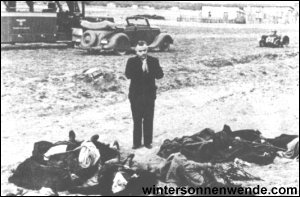
       A Word in Advance This is a translation of Edwin E. Dwinger's 1940 book Der Tod in Polen, die volksdeutsche Passion (Eugen Diederichs Verlag, Jena). While making this book ready for the Internet we had the good fortune of coming across another book on the same subject which contained documentary photographs that fully substantiate the accounts on the pages that follow here. We hesitated for a long time before deciding to add these photos to the text, because many of them are so horrible that they may shock our more sensitive readers. Still, we believe that we owe it to the brutally butchered victims from our grandfathers' generation to bring the graphic evidence of their sufferings to light. In order to somewhat reduce a potential shock, we are adding the photos into the text only in reduced size; anyone who feels up to details can enlarge the pictures by clicking on the appropriate link. The photographs as well as their caption texts are taken from the book The Polish Atrocities Against the German Minority in Poland. Edited and published by order of the Foreign Office and based upon documentary evidence, published in 1940 by Volk und Reich Verlag, Berlin. In the caption texts, "RKPA." indicates findings resulting from the investigation of the Special Police Commission of the Criminal Police Office of the Reich, while "OKW. HS. In." indicates autopsy and post mortem findings. Significantly enough this book is now banned in the vassal state that is modern Germany.
Scriptorium, September 2004,
the 65th anniversary of the events described in this book. 
This book was the hardest of all the tasks that our age has posed me to date in my capacity as chronicler: it contains nothing but the naked truth, every name is that of its true bearer, and every account is based on a sworn affidavit. Edwin Erich Dwinger, 1940
On November 1 of the year 82 BC, after the decisive battle of Colline Gate, Lucius Cornelius Sulla ordered the execution of those lists containing the names of all of tribune Marius's followers. With these public lists, which were called proscriptions even though the term had used to mean only lists with which public sales were announced, Sulla's legionaries went from house to house, killed all those who were named on the lists, raped their women to death, and set most of their houses on fire. Some 2,000 citizens were murdered that day, and proscriptions came to be known forever as calls to kill people who had been outlawed.
 On March 30, 1282 AD, around the time of Vespers on Easter Monday, the people of Palermo rose up against the French who had unlawfully occupied Sicily under Charles of Anjou. Within only a few hours 4,000 French noblemen were killed in Palermo. Their women and children were also not spared. The raging mob dragged them from their houses and tortured them to death in the streets. Like a flame the killing spread through the entire land and marked the beginning of the reign of Peter III of Aragon. Here too, a kind of proscription list was used to identify and eliminate everyone who was pro-French. The uprising itself has gone down in history as the Sicilian Vespers.
On August 23, 1572 AD, Catherine de Medici, then Queen Mother of France, decided to wipe out the Huguenots. She had invited all the important Protestants to Paris to celebrate her son's wedding, and in this case the guest list doubled as the proscriptions. At midnight the alarm bells were suddenly rung, and before most of the Huguenots were fully awake they were already cut down by the henchmen's daggers. The first to fall was their brilliant leader Admiral Collignon. They were plunged out of the windows, their bodies desecrated. This murder spree claimed some 20,000 lives throughout the country and has come to be known as the Massacre of St. Bartholomew's Night.
On September 3, 1939 AD, the third day of the Polish Campaign, Warsaw issued a broadcast. It only stated tersely that Order 59 was to be carried out without delay. This was in fact the secret signal to execute proscriptions that had been prepared well in advance. After this broadcast the Polish people, urged on by their soldiers and officers, descended upon the ethnic Germans and murdered 60,000 of them within a few days. Only few of them were shot, most were brutally beaten to death, and even the corpses were desecrated in great numbers. What is the name under which this deed will go down in history - what will humanity call it one day?
In the westernmost part of Poland, September 3rd was one of those summer days one only finds in the East: the sky devoid of clouds, its blue a bit faded, and with a dry wind blowing in from Russia. In the gardens the trees were weighed down by fruit, along the fences the dahlias were bursting into bloom - if this weather held a bit longer it would make for a bountiful harvest. But would there even be time to bring it in, seeing as war with Germany had broken out two days ago? Just as an impending thunderstorm on a hot day makes itself known in advance, a strange, gloomy tension lay in the air. For months already the Germans had suffered under Polish trespasses, but now there was something new evident in their manner: why did they suddenly look so strangely at the Germans, why did even close acquaintances no longer speak to them? It had still been possible that Sunday morning to attend church in Bromberg without coming to harm, if one avoided speaking German loudly enough to be overheard. At most one had to get out of the way of groups of singing soldiers in the streets, but most Germans did get back to their homes unmolested. And so they now sat in their Sunday best in their rooms, or if there were gardens around their suburban houses, they also sat in the small garden pavilions while the children set the tables for lunch.
Admittedly, since the first day of the war many had been arrested again, primarily
of course the known leaders of the ethnic German movements, but so far no
complaints about the treatment of the arrested Germans had been heard, since
most of them had not returned from the prisons and one could therefore only
conjecture about what was happening to them. Might the upshot of it all be a new
border zone law, after the first had already expropriated so many of them? And so
the German citizens continued to sit silently beside their radios and listened with
pounding hearts to the German stations and to the reports of the German army's
rapid advance. It's only a matter of hours, some said, before we too will be
liberated here! And even if it takes a few more days, said others, all in all our
time of suffering is over...
Death in Poland The Fate of the Ethnic Germans |